
The Church Street neighborhood is poised for a transformational regeneration. Situated in a highly desirable location close to London’s West End, Westminster City Council’s masterplan aims to facilitate estate renewal and economic growth while addressing historic issues of social and economic exclusion.
The masterplan is built upon four primary interconnected drivers: health and well-being, homes, market and enterprise, and making connections.
1. New Homes and an Updated Tenure Mix
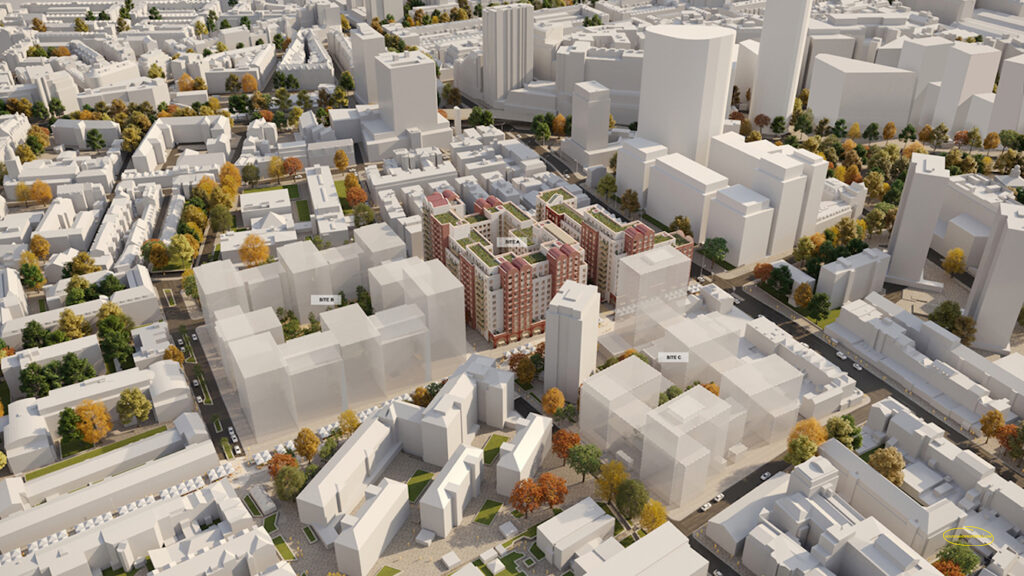
A central objective of the masterplan is to deliver around 1,750 much-needed new homes across a range of types and tenures, with 300 already under construction in the area.
Following local government elections in May 2022, a revised client instruction led to significant updates for Sites A, B, and C to better serve the community’s needs.
- The affordable housing tenure split has been amended to provide 70% social rent homes and 30% intermediate rent, a substantial increase from the previously proposed 40% social rent.
- Site A will deliver 428 total units, achieving a 50/50 split between market sale and affordable homes.
- The affordable allocation for Site A specifically includes 171 Social Rented Units and 42 Intermediate Units (London Living Rent).
- Building designs have been updated to meet the latest fire safety guidance, notably including the mandate for secondary staircases and lifts for all residential dwellings in buildings over 30 meters.
2. The Upgraded Church Street Library
Community engagement heavily influenced the redesign of the Church Street Library, ensuring it meets the demands of a growing population.
- The library footprint has been increased to 605 square meters of gross internal area.
- To maximize accessibility, the facility is now designed entirely on a single level, removing a previously proposed mezzanine.
- The facility features distinct zones: an enlarged adult library, a separated children’s library with buggy storage, a community space, learning rooms, and a visible young adult room.
- A 192-square-meter library garden is integrated into the design, providing a quiet, reflective outdoor space.
3. Church Street Market and Enterprise
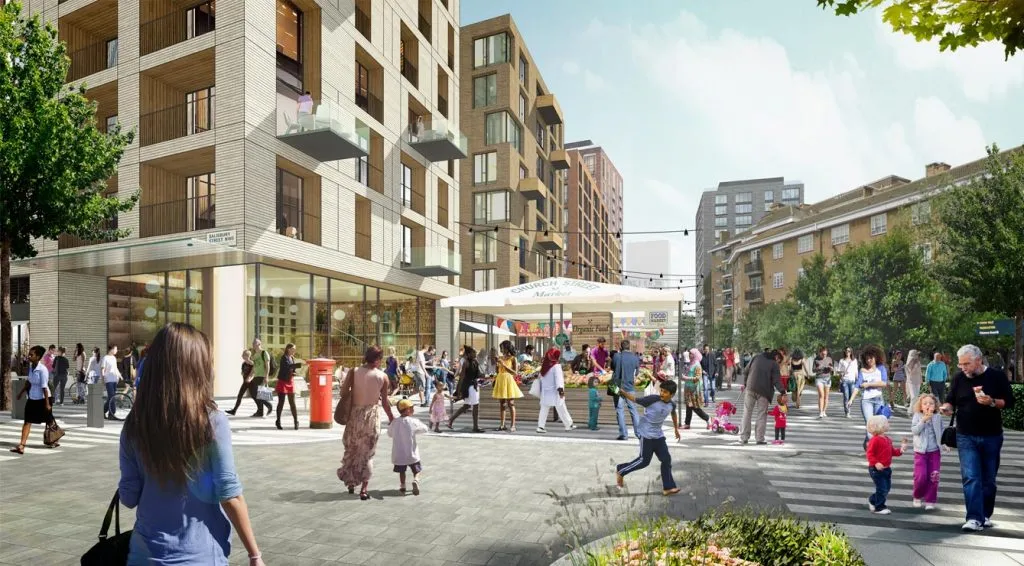
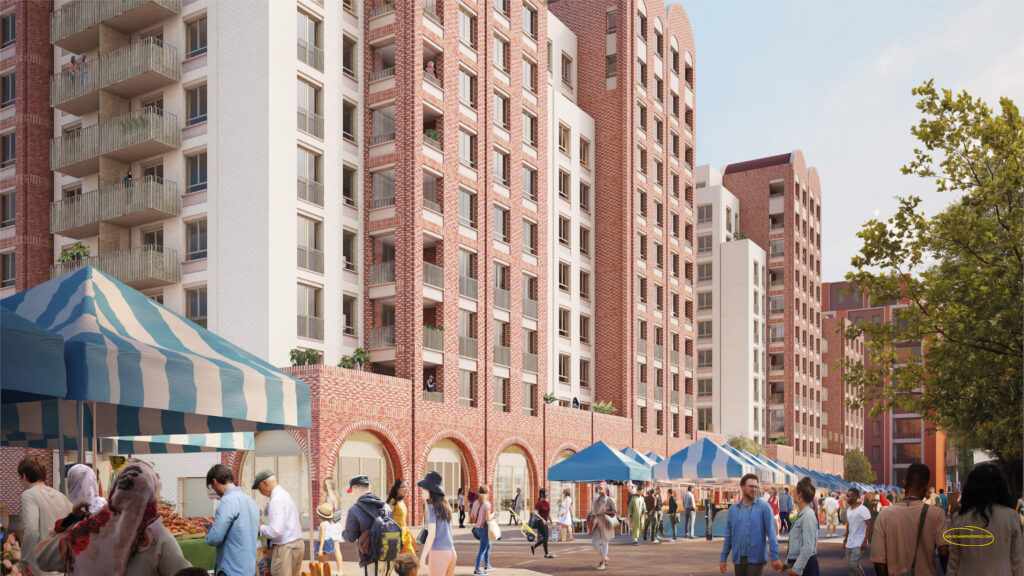
The masterplan recognizes the Church Street Market as the commercial and social heart of the neighborhood.
- The market layout will be redesigned to feature around 220 back-to-back stalls, improving security and sightlines for brick-and-mortar retailers.
- Up to 150 van parking spaces and 3,600 square meters of storage will be provided for traders.
- The regeneration is estimated to generate around 3,500 construction-related jobs and 525 retail jobs.
- A new cultural quarter is planned around the antiques market and Cockpit Theatre to stimulate evening vitality.
4. Health, Green Spaces, and Connectivity
To combat historical issues of social exclusion and poor air quality, the masterplan is landscape-led.
- The project targets up to a 40% increase in publicly accessible open space.
- A central “Green Spine” will run north-south through the area, connecting parks with tree-lined, pedestrian-friendly routes.
- Streets will prioritize pedestrians and cyclists through a 20mph traffic-calmed zone.
5. Community Financial Contributions
To support the infrastructure and environmental goals of the development, several legally binding financial contributions have been secured through a Unilateral Undertaking (Section 106).
| Contribution Type | Amount | Purpose |
| Carbon Offset | £374,184 | Applied to the City of Westminster’s Carbon Offset Fund. |
| TfL Cycle Hire | £220,000 | Enlargement, servicing, or maintenance of local TfL cycle docking stations. |
| Employment & Skills | £128,400 | Initiatives for local employment, training, and the Westminster Employment Service. |
| Electric Vehicle Charging | £50,000 | EV charging infrastructure within the vicinity of the property. |
| Tree Planting | £25,000 | Local tree planting initiatives. |
5. Affordable Housing Allocation and Nominations Criteria
The regeneration prioritizes keeping the existing community intact while expanding the availability of affordable homes.
Tenure Split and Capacities
- Where new affordable housing units constitute an uplift on the existing estate provision, the tenure split (measured by habitable rooms) will be 60-70% Social Rented and 30-40% Intermediate.
- For Site A specifically, the tenure balance was revised to hit exactly 70% social rent and 30% intermediate rent across the affordable provision.
- Site A will provide 213 affordable residential units in total.
- This breaks down into 171 Social Rented Units (98 initially offered to Site A Returning Tenants) and 42 Intermediate/London Living Rent Units (16 initially offered to Site A Returning Leaseholders).
Nominations Criteria (Priority Groups) The allocation of intermediate housing follows a strict, tiered priority system managed by Westminster City Council:
- Priority 1: Social housing tenants giving up their properties in Westminster, followed by Ministry of Defence serving personnel, overcrowded sons and daughters of existing council tenants, and certain households currently in intermediate rented properties.
- Priority 2: Homeless households on the waiting list for social housing (where the council has a statutory duty), followed by all other households on the waiting list.
- Priority 3: Resident workers who have lived and worked in Westminster for at least 12 months, with the first offer going to key workers (such as NHS clinical staff, teachers, police, and qualified social care workers).
- Priority 4: Households living in Westminster for at least 12 months.
- Priority 5: People employed in Westminster for at least 12 months.
6. The Redesigned Church Street Library
Following community and stakeholder feedback, the plans for the library in Site A were heavily revised to maximize space and accessibility.
Layout and Accessibility
- The library footprint was expanded to 605 square meters by incorporating ground-floor corner units originally designated as retail space.
- The design is now entirely on a single level to ensure total accessibility, removing the previously proposed split-level and mezzanine design.
- The facility will be fitted out to a “Category B” standard and provided at a peppercorn rent.
Specific Zones and Facilities
- Adult Library: An enlarged space facing the 192-square-meter garden with direct access and seating.
- Children’s Library: Located on the corner of Church Street and Penfold Street, physically separated from the Adult Library to contain noise, and featuring a dedicated buggy store room.
- Community Space: Situated on the corner of Church Street and New Street Gardens, featuring flexible storage and an accessible kitchen for events.
- Learning & Young Adult Zones: Two separate learning rooms are provided, alongside a Young Adult room positioned adjacent to the reception area so it remains visible and overlooked.
- Amenities: Separate male, female, and accessible WCs, plus dedicated staff offices, a staff kitchen, and a staff WC.
7. Environmental Upgrades and Green Infrastructure
The regeneration relies heavily on a landscape-led approach, recognizing that Church Street currently suffers from a deficiency in both the quality and quantity of open space.
The Green Spine & Public Realm
- The project will yield an up to 40% increase in publicly accessible open space.
- A major feature is the “Green Spine,” a linear green route running north-south through the neighborhood.
- This spine will connect existing spaces like Broadley Street Gardens and Lisson Gardens, extend along pedestrianized routes (like Lisson Street), and eventually bridge over Regent’s Canal to connect with St. John’s Wood.
- The area will implement a 20mph traffic-calmed zone to prioritize pedestrians and cyclists.
Biodiversity and Sustainability
- New buildings and open spaces will incorporate ecological and productive landscapes, including orchards and community food-growing areas.
- The development will utilize Sustainable Urban Drainage Systems (SuDS) and hybrid green/blue or brown roofs to capture rainwater and greywater.
- Green roofs and “living walls” will be integrated to mitigate air pollution and support local biodiversity.
- The developer is legally required to implement “Be Seen” energy performance monitoring, providing the Greater London Authority with accurate, verified energy estimates during the planning, as-built, and in-use stages.
Sustainable Transportation
- To encourage sustainable travel, a Car Club will be established.
- Standard membership for this club will be provided to residents free of charge for a continuous period of 25 years from the date they first occupy a residential unit.